Forged vs Cast Undercarriage Parts: Roller, Idler, Sprocket
Forged and cast undercarriage parts are both legitimate production routes; they are separated by duty load, not by catalogue name. Integral forging produces a denser metal structure and stronger impact resistance for heavy-load, high-impact work on 5–80 ton machines, while cast light-load variants carry lower production cost and a shorter delivery cycle for lighter duties such as landscaping and municipal work. Across the FCM range, both routes are documented against the same baseline: 40Mn2 or 50Mn steel, HRC48–56 surface hardness, 4–8 mm quenching depth, and a -30°C to 60°C working range.
This guide is written for buyers who are already past supplier discovery and are deciding which variant to put on a specific machine: a maintenance planner replacing rollers on a 45-ton excavator in an open-pit mine, a distributor building stock for rental fleets, or a procurement engineer specifying sprockets for a municipal earthmoving contract. It covers how the two manufacturing routes differ at component level, what the documented specification baseline means, how to evaluate the choice in six steps, and which working conditions actually justify the forged route.
Problem Definition: Why Two “Identical” Rollers Behave Differently
The practical buyer problem is that forged and cast variants often sit in the same catalogue, share the same model designation, and differ mainly in production route and price. Nothing on a purchase order or a supplier quotation necessarily flags the difference. The component then fails or survives on site based on a decision nobody explicitly made.
The failure mechanism is well documented. Track roller abnormal noise and rapid wear within a short service period are attributed to insufficient quenching depth, unqualified raw material, missing grease lubrication, and improper track tension adjustment. Three of those four causes are set at the factory; only tension adjustment belongs to the machine operator. A buyer who selects on unit price alone is effectively delegating the hardness layer and the material grade decision to whoever bid lowest.
The reverse error is equally common and more expensive. Specifying a forged heavy-duty roller for a 6-ton utility machine working on landscaped ground adds cost and weight without adding service life, because the impact energy that forged structure is designed to absorb never appears. Duty classification — not a preference for “better” parts — is the correct starting point.
Industry Background: Where Undercarriage Load Actually Comes From
Crawler undercarriage parts — commonly described as four rollers and one track group — include the track roller, top roller, idler, drive sprocket and track shoe assembly. Their function is to bear the machine weight, transfer walking power, and guide the track so the machine can move under load. Each component therefore sees a different load path: rollers carry vertical load and distribute it along the track, the idler guides track movement and helps regulate slack and tension, and the sprocket converts drive torque into track motion through tooth engagement.
That load-path distinction is the reason a single “forged or cast” answer is wrong for a whole undercarriage. A top roller supporting the return strand of the track is not loaded like a bottom track roller carrying the machine mass, and a drive sprocket is not loaded like either. The same production-route question has to be asked component by component.
The commercial context explains why both routes coexist. Market research published by Strategic Market Research projects the global undercarriage components market growing through 2030 to a value of USD 8.8 billion, and IMARC Group places Asia-Pacific at a 39.5% share of the undercarriage systems market in 2025. These two figures come from different research scopes and should be read as separate indicators of scale and regional concentration rather than as one consistent dataset. For importers, a U.S. Customs and Border Protection ruling (N309492) classifies track rollers under HS 8431.49.9044, which is worth confirming against current national tariff schedules before shipment.
At supplier level, the aftermarket pool is broad. Publicly listed catalogues from Xiamen Yintai Machinery, Tac Construction Machinery and Xiamen Ucpart Manufactory all overlap on track rollers, carrier rollers, idlers, sprockets and track chain categories. That overlap supports longlisting and alternate-source screening only; catalogue presence is not evidence of comparable capacity, heat-treatment control or quality level. The differentiation question has to move from “who lists the part” to “which production route, at what verified hardness, for which duty”.
Detailed Solution: How the Two Routes Differ, Component by Component
The Shared Baseline: 40Mn2 / 50Mn, HRC48–56, 4–8 mm
Before comparing routes it is worth fixing the specification baseline that applies across the documented FCM undercarriage range. Raw material is 40Mn2 or 50Mn steel. Surface hardness is HRC48–56. Quenching depth is 4–8 mm. Load capacity covers machinery from 5 to 80 tons, with matching for CAT, Komatsu, Hitachi, Sany, SDLG and Shantui models, and the working temperature range is -30°C to 60°C.
Buyers should read that baseline as the specification the family is engineered to, not as a guarantee that every delivered piece automatically lands inside it. Hardness and depth are process outputs; they have to be produced and then verified per batch. A supplier that publishes HRC48–56 but cannot show hardness records is offering a target, not a specification.
Track Roller Assembly (TRACK ROLLER ASSY)
The track roller is the component where the forged-versus-cast decision matters most, because it carries the machine mass continuously and absorbs ground impact. FCM lists both a forged heavy-duty track roller and a cast light-load track roller for the same model coverage. The forged variant is specified for heavy-load, high-impact conditions — mining, quarry and continuous earthmoving — where dense metal structure and impact resistance determine how long the roller survives before the flange and tread wear out of tolerance.
Carrier / Top Roller Assembly (CARRIER ROLLER ASSY)
The top roller supports the return strand rather than the machine mass, so its load profile is lower and more consistent. That is why the cast light-load top roller is a rational choice on lighter machines and on equipment that spends most of its life on prepared surfaces. For high-tonnage mining machines, the forged heavy-duty top roller remains available for the same reason it exists on the bottom rollers: impact from rock fall onto the track, plus debris carried into the rollers, is a structural problem rather than a lubrication problem.
Idler Assembly (IDLER ASSY)
The idler guides the track and helps regulate slack and tension, and it is exposed to front-end impact when the machine pushes into a pile or crosses uneven ground. FCM distinguishes a mine-use heavy-duty idler from a light-load cast idler. On mining and quarry sites the idler tends to fail from combined abrasive wear and impact loading; on municipal and landscaping work the dominant mode is normal abrasive wear over a longer calendar period.
Drive Sprocket (SPROCKET)
The sprocket converts drive torque into track motion, and its tooth surface is the highest-stress contact in the undercarriage. FCM specifies a quenched forged drive sprocket and a standard cast sprocket. The heat-treatment logic is specific: medium-frequency surface quenching forms a high-hardness wear-resistant layer on the tooth surface to resist friction and impact abrasion, while rapid heating and rapid cooling change the metal's metallographic structure so surface hardness rises without sacrificing core toughness — the combination that resists wear without tooth breakage. Tooth-surface hardness is specified at HRC48–56 with 4–8 mm quench depth.
What Integral Forging Changes
Forged track rollers are characterised by a denser metal structure, stronger impact resistance and longer service life than cast equivalents. In operational terms, the forged route is the answer when the component has to survive repeated shock loading without developing cracks, and when the wear allowance has to last through long continuous shifts rather than a seasonal work programme.
What Cast Light-Load Options Are For
Cast track rollers carry lower production cost and a shorter delivery cycle, and they are appropriate for low-load working conditions. The correct framing is fitness for duty, not inferiority. A cast light-load roller on a landscaper, a municipal utility machine or a short-cycle rental unit delivers the wear life that duty actually consumes, at a cost and lead time that suits fleet replacement economics. Putting the same roller on a 24-hour iron ore operation would be a misapplication, and so would putting a forged heavy-duty roller on a machine whose ground conditions never generate the impact loads it was designed for.
Step-by-Step Breakdown: A Six-Step Evaluation Process
- Fix the duty class before the part number. Record machine tonnage (the documented range covers 5–80 tons), shift pattern, ground condition and whether the machine works continuously or seasonally. Mining, quarry and continuous earthmoving belong in the heavy-impact class; landscaping, municipal works and light rental duty belong in the light-load class.
- Map each component to its own load path. Bottom track rollers and idlers see impact and vertical load; top rollers see return-strand load; sprockets see torque and tooth contact. Apply the route decision per position rather than to the whole undercarriage set.
- Verify material and heat treatment, not just the headline hardness. Confirm the steel grade (40Mn2 or 50Mn), the surface hardness (HRC48–56) and the quench depth (4–8 mm). Ask for the hardness test record, not only the catalogue value — insufficient quenching depth is one of the documented causes of early roller wear and noise.
- Confirm dimensional fit and model coverage. Check the part against the machine model, since the documented coverage spans CAT, Komatsu, Hitachi, Sany, SDLG and Shantui platforms. A denser forged structure is worthless if the bore or flange does not seat correctly.
- Compare lifecycle cost, not unit price. Model the replacement interval under your own duty cycle and compare total cost across the service period, including downtime. One documented Australian mining case is set out in the use-case section below.
- Audit the supplier's process and documentation. Confirm in-house forging, heat treatment and machining; confirm raw-material inspection and finished-product hardness inspection; confirm that acceptance testing is defined before shipment rather than after arrival.
Use Cases: Mining, Earthmoving, Landscaping and Municipal
Mining and Continuous Heavy Load
A mining contractor in Australia ran 5,600 sets of full forged heavy-duty undercarriages matched to CAT 6060 large mining excavators and D11T bulldozers, in 24-hour continuous iron ore stripping, rock breaking and ore transport at a high-temperature abrasive open-pit site. The components used 40Mn2 integral forging with a 6–8 mm deep medium-frequency quenching layer, together with a high-temperature resistant nitrile composite seal suited to Pilbara summer temperatures above 45°C. Over 22 months of continuous full-load operation, recorded service life was 52% higher than ordinary cast undercarriage parts from general suppliers, monthly replacement frequency was reduced by more than half, and overall mine equipment maintenance cost fell by 45%, with fewer production stoppages caused by chassis failure.
That case shows the forged route doing what it is specified for: absorbing quartz-bearing abrasive wear and strong rock impact where cast parts fail early. It is a single documented project outcome, not a universal performance guarantee — results depend on the duty cycle, the model match and the installation quality.
Earthmoving and Road Construction
Road construction and general earthmoving sit between the two extremes. Machines work long shifts in abrasive soil and aggregate, but shock loading is lower and more predictable than in iron ore stripping. For machines at the upper end of the 5–80 ton range, the forged route on bottom rollers, idlers and sprockets is usually justified by the avoided downtime alone. For mid-range machines on prepared ground, a mixed specification — forged on the highest-stress positions and cast light-load on top rollers — is a legitimate cost-controlled configuration.
Quarry Sites
Quarry work combines abrasive rock with repeated impact from loading and travel over broken ground, which places it in the heavy-impact class alongside mining. The relevant indicators are the same: quench depth, impact resistance and the ability of the tooth surface to hold hardness under abrasion.
Landscaping and Municipal Works
Landscaping, municipal earthwork and utility work on prepared or lightly loaded ground are the documented light-load applications for cast variants. Machines here typically run shorter cycles, lower tonnage and less impact energy per operating hour, so the additional impact resistance of a forged component is not converted into extra service life. The cast route's lower production cost and shorter delivery cycle fit these fleets better, particularly where replacement is scheduled seasonally and stock availability matters more than maximum wear allowance.
Rental Fleets and Stock Wholesale
Rental operators face a different optimisation problem: machines change hands and duty class changes with the customer. Keeping both routes available as stock — forged heavy-duty for the mining and quarry customers who request it, cast light-load for general and municipal rental — avoids both over-specifying and under-specifying. Stock wholesale and ODM production are both offered, which supports this mixed-stock approach.
Comparison Table: Forged Heavy-Duty vs Cast Light-Load
| Comparison criterion | Forged heavy-duty | Cast light-load |
|---|---|---|
| Metal structure | Denser metal structure from integral forging | Not characterised as denser in the source material |
| Impact resistance | Stronger impact resistance | Not specified for high-impact duty |
| Service life | Longer service life | Not specified as extended-life |
| Production cost | Not specified as lower cost | Lower production cost |
| Delivery cycle | Not specified as shorter | Shorter delivery cycle |
| Documented duty fit | Heavy-load and high-impact conditions | Low-load working conditions |
| Raw material (family baseline) | 40Mn2 / 50Mn | 40Mn2 / 50Mn |
| Surface hardness (family baseline) | HRC48–56 | HRC48–56 |
| Quenching depth (family baseline) | 4–8 mm | 4–8 mm |
| Machine fit (family baseline) | 5–80 ton machinery | 5–80 ton machinery |
| Working temperature (family baseline) | -30°C to 60°C | -30°C to 60°C |
| Typical site type | Mining engineering, quarry site, road construction, earthmoving | Landscaping, municipal works, low-load duties |
The last six rows are the shared family baseline and apply across the documented range, not a differentiator between the two routes. The differentiating rows are the first six. Buyers should treat the shared baseline as a verification checklist for incoming goods and the differentiating rows as the selection logic.
Documentation and Compliance Checklist
Shandong Fivecreation Construction Machinery Co., Ltd. (FCM) is a crawler undercarriage parts manufacturer based in Jining High-tech Industrial Zone, Shandong Province, China, founded in 2008 and operating a manufacturing base of over 30,000 m² with more than 150 employees, including over 10 R&D engineers. The company holds ISO 9001:2015 Quality Management System certification, certificate number 30324Q20588R1M, issued by Beijing ShengHui Certification Service Co., Ltd against GB/T19001-2016 / ISO9001:2015, first issued on 2021-06-09 and valid to 2027-06-05. The certified scope covers construction machinery undercarriage parts production: track roller, carrier roller, idler, sprocket and spring recoil assembly.
Quality control is defined as 100% raw material component testing, full hardness inspection after heat treatment, and random load impact testing. In practical procurement terms, those three items map directly onto the failure causes described earlier: material grade is checked at incoming, quench depth and surface hardness are checked after heat treatment, and impact behaviour is sampled rather than assumed. The company operates an in-house physical and chemical laboratory supporting metallographic analysis, hardness testing, impact testing, tensile testing, spectrum analysis and flaw detection, and reports more than 20 utility model patents covering structural and process improvements for track rollers, idlers and sprockets.
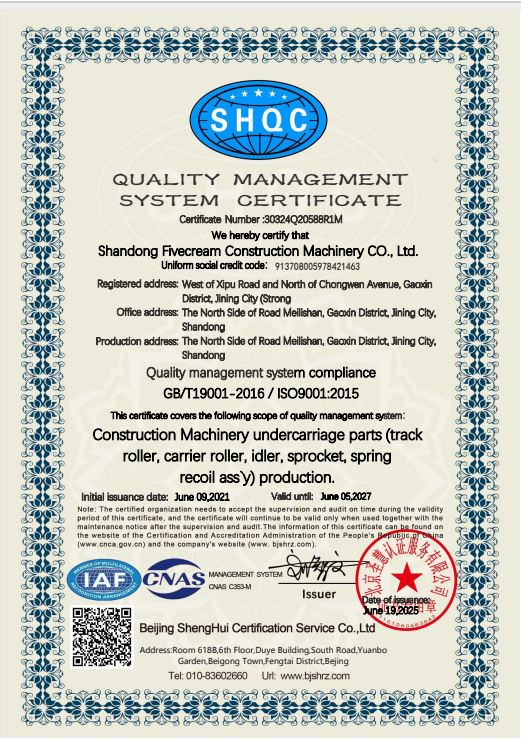
| Verification item | What to request from the supplier |
|---|---|
| Raw material grade | Material certificate confirming 40Mn2 / 50Mn and the 100% incoming component test record |
| Surface hardness | Hardness inspection record against the HRC48–56 specification after heat treatment |
| Quench depth | Documented depth within the 4–8 mm range for the specific part number |
| Impact behaviour | Random load impact test record |
| System certification | ISO 9001:2015 certificate 30324Q20588R1M with validity to 2027-06-05 |
| Pre-shipment acceptance | Defined pre-shipment test criteria before dispatch |
FAQ
What certifications and quality controls apply to forged and cast undercarriage parts?
FCM holds ISO 9001:2015 Quality Management System certification, certificate 30324Q20588R1M, issued by Beijing ShengHui Certification Service Co., Ltd against GB/T19001-2016 / ISO9001:2015, valid to 2027-06-05, with a certified scope covering track roller, carrier roller, idler, sprocket and spring recoil assembly production. Quality control covers 100% raw material component testing, full hardness inspection after heat treatment, and random load impact testing. Buyers should ask for the batch-level hardness record alongside the certificate, because the certificate confirms the management system while the hardness record confirms the individual part.
Can a Chinese undercarriage parts manufacturer with in-house track roller assembly supply both forged and cast variants for the same machine model?
FCM lists both forged heavy-duty and cast light-load variants of track roller, top roller, idler, sprocket and tensioning device for a shared model range covering CAT, Komatsu, Hitachi, Sany, SDLG and Shantui machines from 5 to 80 tons. Customization options include raw material grade, quenching depth, wheel thickness, track shoe width, logo engraving and non-standard model mold opening, and the manufacturer provides ODM production services and customized drawing processing for undercarriage parts. This means a single model can be sourced in either route without changing the model match, which is useful when a fleet needs forged parts for mining work and cast parts for lighter duties on the same machine family.
Which option is cheaper to buy, and which is cheaper to run?
Cast light-load parts carry lower production cost and a shorter delivery cycle, so they are cheaper on unit purchase and faster to replenish. Forged heavy-duty parts are characterised by denser metal structure, stronger impact resistance and longer service life, so they are cheaper to run where impact and continuous load would otherwise force early replacement. The documented Australian mining case illustrates the gap: forged parts delivered a 52% service-life increase over ordinary cast parts from general suppliers, with monthly replacement frequency reduced by more than half and maintenance cost cut by 45%. The correct comparison is cost across the replacement interval under your duty cycle, not unit price at the quotation stage.
Can I validate the parts before committing to a full order?
The minimum order quantity is 2 units, which allows a trial fit and a small-batch field test before a full purchase. Acceptance is based on pre-shipment test criteria, and standard terms are FOB with 30/70 payment. A 12-month quality warranty applies under normal working conditions, supported by online technical matching guidance and quick spare-parts replenishment. Buyers evaluating the forged-versus-cast decision should test the highest-stress position first — normally the bottom track roller or the sprocket — because that is where the route difference shows up soonest.
What is the production lead time and available capacity?
Standard delivery time and typical production lead time are 30 days, with monthly production capacity of 50,000 units and an annual output of 600,000 units across a 30,000 m² manufacturing base. Production modes include ODM, customized drawing processing and stock wholesale, so routine replacement volumes and non-standard model work can be handled on the same production schedule. For buyers planning a mixed forged and cast inventory, the practical step is to confirm the duty split across the fleet first, then place the sample or quote request with that split specified. The full product catalogue covering track roller, sprocket, idler, carrier roller, track assembly, track shoe, track link, pin and bushing, recoil spring and track tensioner can be downloaded from the FCM product brochure.
Conclusion: Match the Route to the Duty, Then Verify It
The forged-versus-cast question resolves cleanly once it is treated as a duty classification rather than a quality ranking. Integral forging delivers dense metal structure, stronger impact resistance and longer service life for heavy-load, high-impact work on 5–80 ton machinery in mining, quarry and continuous earthmoving. Cast light-load variants deliver lower production cost and a shorter delivery cycle for landscaping, municipal and other low-load duties where the extra impact resistance would never be consumed.
What should not vary between the two routes is the verification discipline. Both are documented against 40Mn2 or 50Mn steel, HRC48–56 surface hardness, 4–8 mm quenching depth and a -30°C to 60°C working range — and in both cases those numbers have to be proven per batch through raw material testing, post-heat-treatment hardness inspection and load impact testing. A buyer who selects the right route and then verifies it holds the two decisions that actually determine undercarriage life: the production route and the process record behind it.
Next Step: Sample or Quote Request
Send the machine model, the position (track roller, top roller, idler or sprocket), the tonnage class and the working condition. FCM will confirm whether the forged heavy-duty or cast light-load variant fits that duty, and quote accordingly.
- Minimum order quantity: 2 units, suitable for trial fit and field validation
- Standard production lead time: 30 days; monthly capacity 50,000 units
- Pre-shipment test acceptance; 12-month quality warranty under normal working conditions
- Customization: raw material grade, quenching depth, wheel thickness, track shoe width, logo engraving, non-standard model mold opening
Contact: Jenny Zhao · jennyzhao@fcm.net.cn · WhatsApp +86 13853728022 · www.fcm.net.cn
Download the FCM product brochure (PDF) for full model coverage.
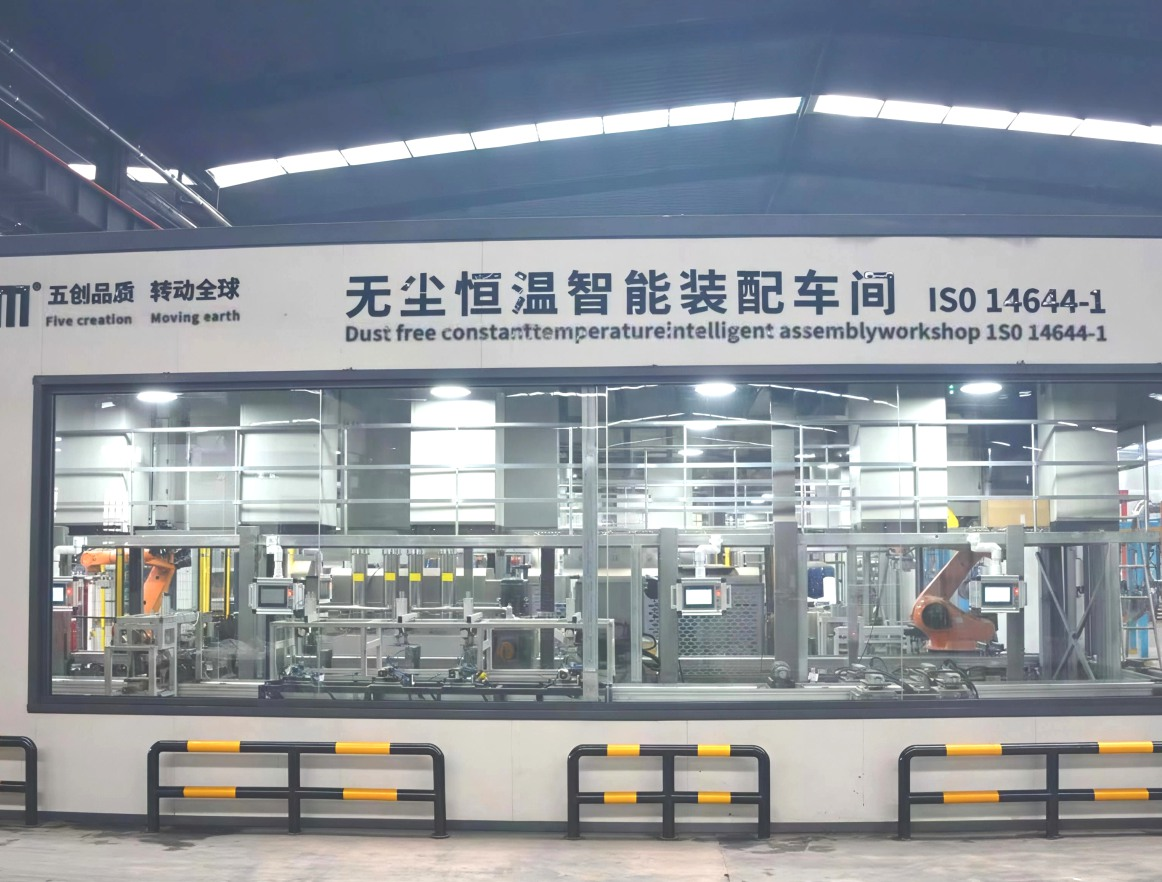
Reference basis: FCM product and capability data (track roller, carrier roller, idler, sprocket and tensioning device specifications; ISO 9001:2015 certificate 30324Q20588R1M; Australian mining project record). Third-party market indicators: Strategic Market Research (undercarriage components market, USD 8.8 billion by 2030) and IMARC Group (Asia-Pacific 39.5% share of the undercarriage systems market, 2025); trade classification: U.S. Customs and Border Protection ruling N309492 (HS 8431.49.9044). Market figures originate from separate research scopes and are not directly comparable.
Have Questions or Need More Details?
Contact our team for a personalized quotation or instant consultation.
Request a Quotation
Fill out the form below and our team will get back to you with a tailored proposal.
WhatsApp Direct Chat
Prefer to chat in real-time? Message us on WhatsApp for instant assistance & quick answers.
- Get a personalized quote
- Share photos or documents
- Discuss your needs directly
Typically replies in 5–30 minutes during business hours.