Undercarriage Parts for Quarry and Mining Sites: Matching Heavy-Duty vs Standard to 5–80 Ton Fleets
Quarry and mining work does not wear an undercarriage the way general construction does. A 24-hour continuous heavy-load cycle, stone impact at the face, abrasive ore, frequent forward and reverse travel, and a working range that runs from -30°C to 60°C remove rollers, idlers and sprockets on a very different schedule than a machine that levels a field twice a year.
That is why the same 5–80 ton crawler machine can be fitted with two quite different grades of undercarriage parts, and why picking the wrong one costs money in both directions. This guide maps the grades in the Fivecreation Construction Machinery (FCM) crawler undercarriage range to real site conditions, so a fleet manager or procurement team can specify by duty level rather than by habit.
Direct answer: For quarry faces, open-pit mining, road reconstruction and other 24-hour heavy-load duties, specify mine-use heavy-duty idlers, forged heavy-duty track rollers and top rollers, quenched forged drive sprockets and mining-grade heavy-duty tensioner assemblies. For landscaping, municipal earthworks and short-term rental equipment running light loads, standard cast grades cover the duty. Match the grade to duty cycle, impact level and temperature, not to machine tonnage alone.
Why the grade decision matters more than the part number
Undercarriage parts are bought twice: once at the counter, and again every time they fail early. In quarry and mining applications the second purchase is the expensive one, because a track group failure stops a production machine, not a spare unit.
Direction one: standard cast grades inside a heavy-load cycle
Standard cast grades are produced for low-load working conditions, where lower production cost and a shorter delivery cycle matter more than impact resistance. Put that same component into a 24-hour quarry cycle and the wear mechanisms change: continuous contact stress, abrasive rock, and shock loads from stone impact accumulate faster than a light-load design is intended to absorb.
Field troubleshooting points to the same root causes again and again — insufficient quenching depth, inferior raw material, missing grease lubrication, and incorrect track tension adjustment. The visible symptoms are abnormal noise and severe wear within a short service time. All four causes are addressable at the specification stage, before the part ever reaches the site.
Direction two: heavy-duty parts on a light-duty machine
The opposite error is quieter but still real. Integral forged heavy-duty components carry higher production cost. Where a machine works intermittent light loads — landscaping, municipal trenching, short rental cycles — that extra impact resistance is never used, and capital sits in the wear layer instead of in the fleet.
Dimension fit also decides whether a rebuild goes to plan. Complete model matching with high dimensional precision is what removes rework during on-site installation, which is why model coverage and tolerance discipline belong in the same conversation as grade selection.
Industry background: what quarry and mining duty actually demands
The operating envelope
Crawler undercarriage parts in this segment are used across mining engineering, road construction, earthmoving, landscaping, municipal works, stone quarry and tunnel engineering. The working condition they are designed around is specific: outdoor open-pit mine, muddy construction site, stone impact environment, a -30°C to 60°C temperature range, and heavy continuous load.
The operation mode is equally specific — 24-hour continuous heavy-load cyclic operation with frequent forward and reverse walking, on crawler excavators, crawler bulldozers and crawler loaders. In that envelope, four requirements dominate the specification:
- High wear resistance against abrasive rock and ore.
- Strong impact resistance against stone strike and drop loading.
- Anti-seepage lubrication seals that keep grease in and grit out.
- Long service cycle, because the maintenance window is the production window.
Where the demand is coming from
Strategic Market Research projects the global undercarriage components market to reach USD 8.8 billion by 2030, growing at a 5.8% CAGR. IMARC Group places Asia-Pacific at 39.5% share of the undercarriage systems market in 2025. Research houses define the market boundary differently — components, systems, or the wider tracked-vehicle aftermarket — so these figures are best read as directional rather than as a single like-for-like number.
For import planning, one concrete reference point helps: U.S. Customs and Border Protection ruling N309492 classifies track rollers under HS 8431.49.9044. Buyers comparing landed cost should confirm their own tariff line with a customs broker, since generic trade listings often quote broader codes.
The detailed solution: mapping four roller groups and one track group to site conditions
The FCM crawler undercarriage range is built around four rollers and one track group — track roller, carrier roller (top roller), idler, sprocket and track assembly — with the wear-critical items offered in two grades. The grade names below match the catalogue, so they can be used directly in an RFQ.
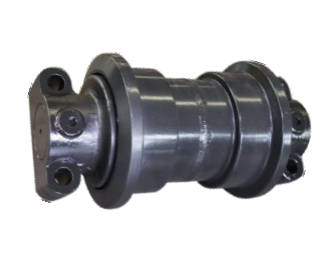
Track Roller Assy: Forged Heavy-Duty vs Cast Light-Load
The track roller supports the whole weight of the machine, transfers that weight to the ground, rolls along the track surface, and limits lateral track slip. During mechanical steering the rollers force the track to slide on the ground, which is why they absorb the highest combination of load and abrasion in the group.
Forged Heavy-Duty Track Roller uses 40Mn2/50Mn with integral forging for a dense metal texture and strong impact resistance, then automatic medium-frequency quenching to build a 4–8 mm wear-resistant layer at HRC48–56. A multi-layer composite oil seal handles leakage and high temperature. Cast Light-Load Track Roller covers low-load duty, where lower production cost and a shorter delivery cycle are the deciding factors.
Idler Assy: Mine-Use Heavy-Duty vs Light-Load Cast Idler
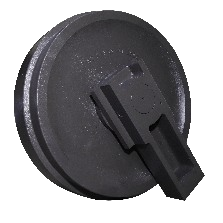
The idler guides the track to rotate correctly and prevents it from deviating, keeping the machine stable during travel and avoiding mechanical failures caused by track deviation. On a quarry face the idler sits at the point where the track meets rock and debris, so the front-end impact load is continuous.
Mine-Use Heavy-Duty Idler follows the same forging and quenching route as the heavy-duty roller: 40Mn2/50Mn, HRC48–56, 4–8 mm quench depth, multi-layer composite oil seal. Light-Load Cast Idler is intended for the lighter duty cycles described above. Model coverage for both runs across the 5–80 ton class.
Carrier Roller Assy (Top Roller): Forged Heavy-Duty vs Cast Light-Load
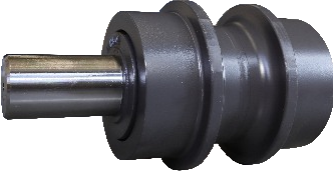
The carrier roller supports the track and prevents it from sagging too much, which reduces the track jumping phenomenon during movement and prevents sideways sliding. It carries less vertical load than the track roller but works in a hotter, dirtier position, so seal quality and quenching depth show up quickly in service life.
Forged Heavy-Duty Top Roller uses integral forging for impact resistance, automatic medium-frequency quenching for the 4–8 mm wear layer, and a multi-layer composite oil seal for anti-leakage and high-temperature resistance. Cast Light-Load Top Roller is the standard-grade alternative for light-load applications.
Sprocket: Quenched Forged Drive Sprocket vs Standard Cast Sprocket
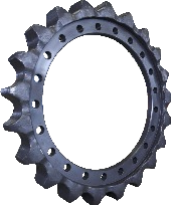
The sprocket transmits the drive power generated by the engine, generator or motor of the equipment to the tracks, providing the traction that moves the machine forward, backward or into a turn. It is the component most exposed to tooth loading, and tooth breakage is the failure mode that takes a machine off the face immediately.
Medium-frequency surface quenching forms a high-hardness wear-resistant layer on the tooth surface to resist friction and impact abrasion. Rapid heating and rapid cooling change the metal metallographic structure, raising surface hardness while keeping inner toughness, which is precisely what limits tooth breakage. Quenched Forged Drive Sprocket adds integral forging to that process — dense metal texture, strong impact resistance — plus precise tooth profile processing for good meshing with the track. Standard Cast Sprocket remains available for light-load duty.
Tensioning Device: Mining-Grade Heavy-Duty vs Standard Tensioner Assembly
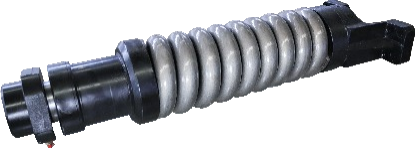
The tensioning device keeps the track at proper tension and alleviates the impact force coming from the road when walking, reducing fuselage vibration. A loose track causes vibration during travel, and excessive slack can derail the track. An over-tight track increases friction between the track pin and bushing, as well as at the idler and sprocket, accelerating their wear.
Mining-Grade Heavy-Duty Tensioner Assembly uses heavy-duty integral forging for key structural parts, automatic medium-frequency quenching on wear parts for a 4–8 mm layer, and a high-pressure resistant seal structure to prevent grease leakage. Standard Tensioner Assembly covers regular duty cycles. Both grades are specified with 40Mn2/50Mn for key structural parts, fit 5–80 ton machinery and are rated for -30°C to 60°C.
Track group, track shoe, track link, pin and bushing, recoil spring
The track group closes the loop. Track Assy, Track Shoe, Track Link, Pin & Bushing and Recoil Spring work as a system with the four roller groups, and they are where ground pressure and grip are set. In muddy or soft ground, a wider shoe lowers ground pressure; in rock, the shoe and link wear pattern follows the same abrasive cycle as the rollers. FCM supports customisation of track shoe width alongside raw material grade, quenching depth, wheel thickness and logo engraving.
Step-by-step: selecting grades for a 5–80 ton fleet
- Classify the duty cycle. A machine on 24-hour continuous heavy-load cyclic operation with frequent forward and reverse walking belongs in the heavy-duty grade. Intermittent light-load work belongs in the standard grade. Do this per machine, not per site.
- Classify abrasion and impact. Stone impact environments, hard rock quarry faces and abrasive ore push the track roller, idler and sprocket to heavy-duty. Muddy construction sites with soft ground shift the emphasis to sealing and shoe width.
- Confirm tonnage class and model fit. The range is rated for 5–80 ton machinery, with matching for CAT, Komatsu, Hitachi, Sany, SDLG and Shantui. Confirm the exact model before ordering; dimensional precision is what prevents rework at installation.
- Fix material and heat treatment on the RFQ. State 40Mn2/50Mn, surface hardness HRC48–56 and quench depth 4–8 mm, so the quotation and the inspection report are measured against the same standard.
- Specify sealing and temperature. For sites running from -30°C to 60°C, and for high-temperature open-pit work, confirm the seal compound. In the Australian iron ore reference below, a high-temperature resistant nitrile composite seal was specified for summer conditions above 45°C.
- Require inspection evidence. 100% raw material component test, full hardness inspection after heat treatment, and random load impact test. Ask for the report that corresponds to the delivered batch.
- Plan the replenishment. With a 50,000 pcs monthly capacity, a 30-day lead time, MOQ from 2 units and a 12-month quality warranty under normal working condition, a fleet rollout can be staged rather than ordered in one block.
Grade selection matrix by component and site condition
| Component | Standard grade | Heavy-duty grade | Specify the heavy-duty grade when |
|---|---|---|---|
| Track Roller Assy | Cast Light-Load Track Roller | Forged Heavy-Duty Track Roller | 24-hour continuous heavy load, stone impact, frequent counter-rotation steering |
| Idler Assy | Light-Load Cast Idler | Mine-Use Heavy-Duty Idler | Front-end impact from rock and debris, deviation load on the track frame |
| Carrier Roller Assy (Top Roller) | Cast Light-Load Top Roller | Forged Heavy-Duty Top Roller | Long track span, high sag load, high ambient temperature |
| Sprocket | Standard Cast Sprocket | Quenched Forged Drive Sprocket | High torque digging or dozing, tooth breakage risk, abrasive ground |
| Tensioning Device | Standard Tensioner Assembly | Mining-Grade Heavy-Duty Tensioner Assembly | High-impact travel, grease leakage risk, wide temperature swing |
| Track Assy / Track Shoe / Track Link / Pin & Bushing / Recoil Spring | Standard assemblies | Reinforced track shoe assembly and matching heavy-duty running gear | Soft or muddy ground requiring wider shoe and lower ground pressure, plus abrasive rock wear |
Heavy-duty vs standard: a like-for-like comparison
| Attribute | Standard grade (cast, light-load) | Heavy-duty grade (forged, mine-use) |
|---|---|---|
| Forming method | Casting | Integral forging |
| Metal structure and impact behaviour | Lower production cost and shorter delivery cycle for low-load working conditions | Dense metal texture, strong impact resistance, anti-tooth-breaking behaviour on sprockets |
| Wear layer | Standard surface treatment | Automatic medium-frequency quenching, 4–8 mm wear-resistant layer, HRC48–56 |
| Sealing | Per model specification | Multi-layer composite oil seal, anti-leakage and high-temperature resistant |
| Intended duty | Light-load landscaping, short-term rental equipment | Heavy mining, stone yard and long-term engineering construction with high impact load |
| Fitment and temperature | 5–80 ton machinery, -30°C to 60°C | 5–80 ton machinery, -30°C to 60°C |
| Commercial support | 12-month quality warranty, full-process inspection before shipment | 12-month quality warranty, full-process inspection before shipment, ODM customisation, free logo engraving |
Both grades share the same catalogue material basis (40Mn2/50Mn), the same HRC48–56 surface hardness target and the same -30°C to 60°C working range. The difference is the forming method and the duty level each grade is designed for, which is why the selection should be made on duty cycle rather than on hardness alone.
Use cases by site type
Mountain stone quarry
Stone impact environments are the defining condition. Track rollers, idlers and sprockets take repeated shock loads as the track picks up rock fragments, and the wear layer is abraded rather than worn evenly. Mine-use heavy-duty idlers and forged heavy-duty track rollers are the appropriate specification here, with quenched forged sprockets where digging torque is high.
Open-pit iron ore: the Australian reference project
A mining contractor in Australia ran 5,600 sets of full forged heavy-duty undercarriages on CAT 6060 large mining excavators and D11T bulldozers, in 24-hour continuous iron ore stripping, rock breaking and ore transportation at a high-temperature abrasive open-pit iron mine. The project ran 22 months of full-load operation under extreme mining conditions.
The specification combined 40Mn2 integral forging with a 6–8 mm deep medium-frequency quench layer to resist sharp quartz-type abrasive wear and strong rock impact, plus a high-temperature resistant nitrile composite seal for summer conditions above 45°C. Reported results against ordinary cast undercarriage parts from general suppliers: service life increased by 52%, monthly replacement frequency reduced by more than half, overall mine equipment maintenance cost cut by 45%, and fewer production shutdown losses caused by chassis failure. The same project noted high dimensional precision with no rework during on-site installation.
National road reconstruction and highway construction
Road work is heavy continuous load rather than stone impact. Track abrasion is the dominant wear mode on crawler bulldozers and pavers, so high wear resistance and correct track tension matter more than extreme impact resistance. Standard grade can be defensible on short, light contracts; long reconstruction programmes with continuous shifts justify the heavy-duty grade on the running gear.
Municipal earthworks and farm land leveling
Muddy construction sites change the requirement. Here the special requirement is anti-seepage lubrication seals, because contamination of the grease is the fastest route to roller failure, and the role of the undercarriage is to keep stable walking performance rather than to survive rock strike. This is the segment where standard cast grades often make the most economic sense, with shoe width adjusted for ground pressure.
Tunnel engineering
Tunnel work combines confined travel, frequent forward and reverse positioning, and abrasive debris underfoot. The duty is closer to quarry duty than to road work, particularly for the sprocket and idler, and the track tensioner is stressed by repeated short reversing cycles — a case for the mining-grade tensioner assembly rather than the standard unit.
Model coverage for 5–80 ton fleets
| Brand | Example models covered in the range | Typical fleet role |
|---|---|---|
| CAT | D11T, D10N, D9R, D8T, E390, E374, E349 | Large dozing and mass excavation in quarry and mine |
| Komatsu | D475A, D375A, D355A/D275A, D155A, D65A, PC200, PC650, PC1250, PC2000 | Production dozing, loading and ore transport support |
| Hitachi | EX1200, EX200 | Mining-class and standard excavator duty |
| Sany | SY215, SY375, SY980 | Mixed quarry and construction fleets |
| SDLG | Covered within the same 5–80 ton matching range | Earthmoving and municipal fleets |
| Shantui | Covered within the same 5–80 ton matching range | Bulldozer-heavy road and site preparation fleets |
Model lists indicate catalogue coverage only. Confirm the exact machine serial and shoe configuration before placing a fleet order.
Shortlisting manufacturers for an excavator fleet replacement project
Fleet replacement projects fail on two things: a supplier whose catalogue covers one component family but not the whole group, and a supplier who can quote a part number but not the grade behind it. Six screens separate the two.
- Grade depth, not just product names. Ask whether the supplier offers both a standard and a heavy-duty version of the track roller, idler, top roller, sprocket and tensioner, and whether the grade names map to documented material and heat-treatment specifications.
- Material and heat-treatment evidence. 40Mn2/50Mn, HRC48–56 and 4–8 mm quench depth should appear on the drawing or the inspection report, not only in a brochure.
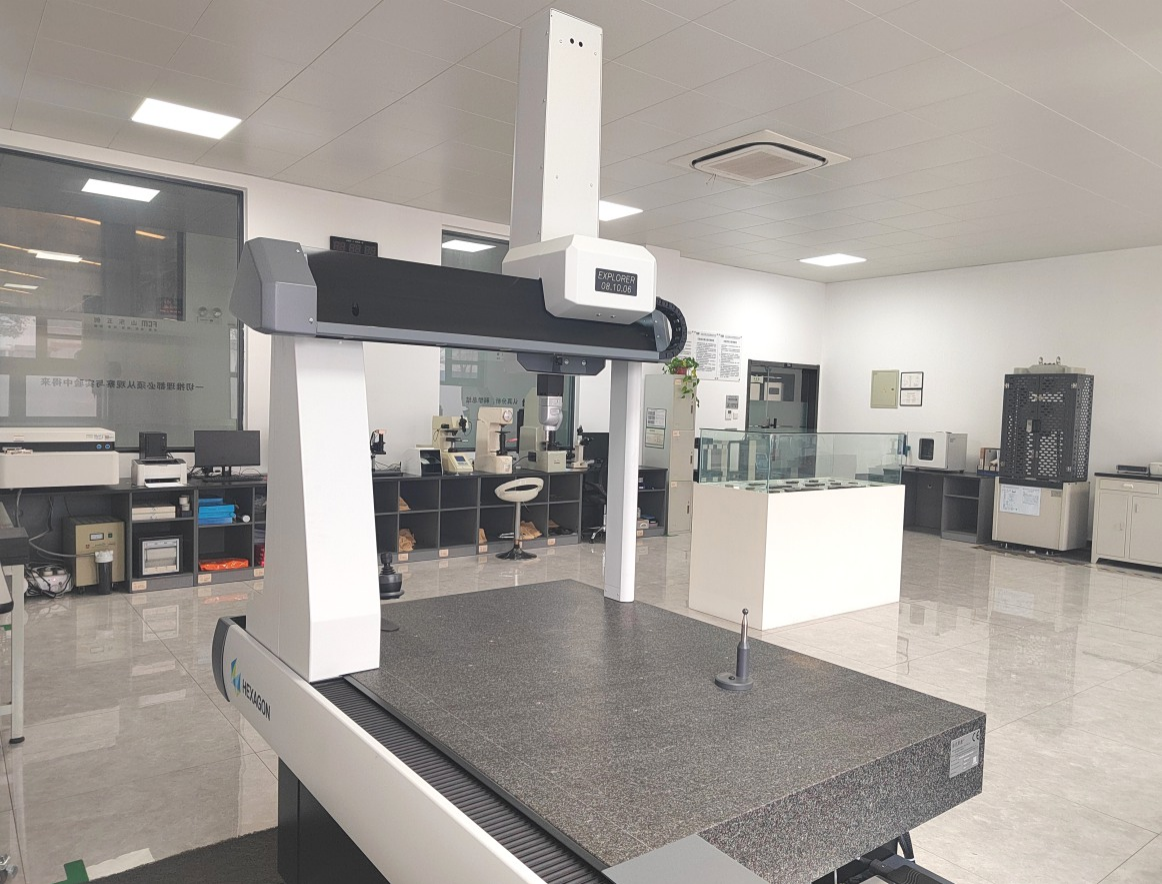
- In-process inspection. 100% raw material component test, full hardness inspection after heat treatment and random load impact test, backed by an in-house laboratory with spectrum analysis, metallographic, hardness, impact and flaw-detection capability.
- Customisation capability. Raw material grade, quenching depth, wheel thickness, track shoe width, logo engraving and non-standard model mould opening.
- Delivery discipline. Monthly capacity, stated lead time and stock depth for the mainstream models in your fleet.
- Warranty and technical support. A defined warranty period plus online technical matching guidance and spare parts replenishment.
At catalogue level, several China-based suppliers publicly list overlapping crawler undercarriage categories — Yintai lists track chain, track shoe, rollers, idler, sprocket and recoil spring; Tac Construction Machinery lists rollers, sprocket rims and segments, idlers and track groups with shoes; UCPART lists rollers, sprockets, idlers, links, chains, pins and bushings. Fivecreation appears in the same catalog-level comparison with track rollers, carrier rollers, idlers, recoil springs, track links, track shoes and sprocket segments. Catalog presence is a longlisting signal only; it is not evidence of capacity, quality or supplier equivalence, and this article does not rank these suppliers.
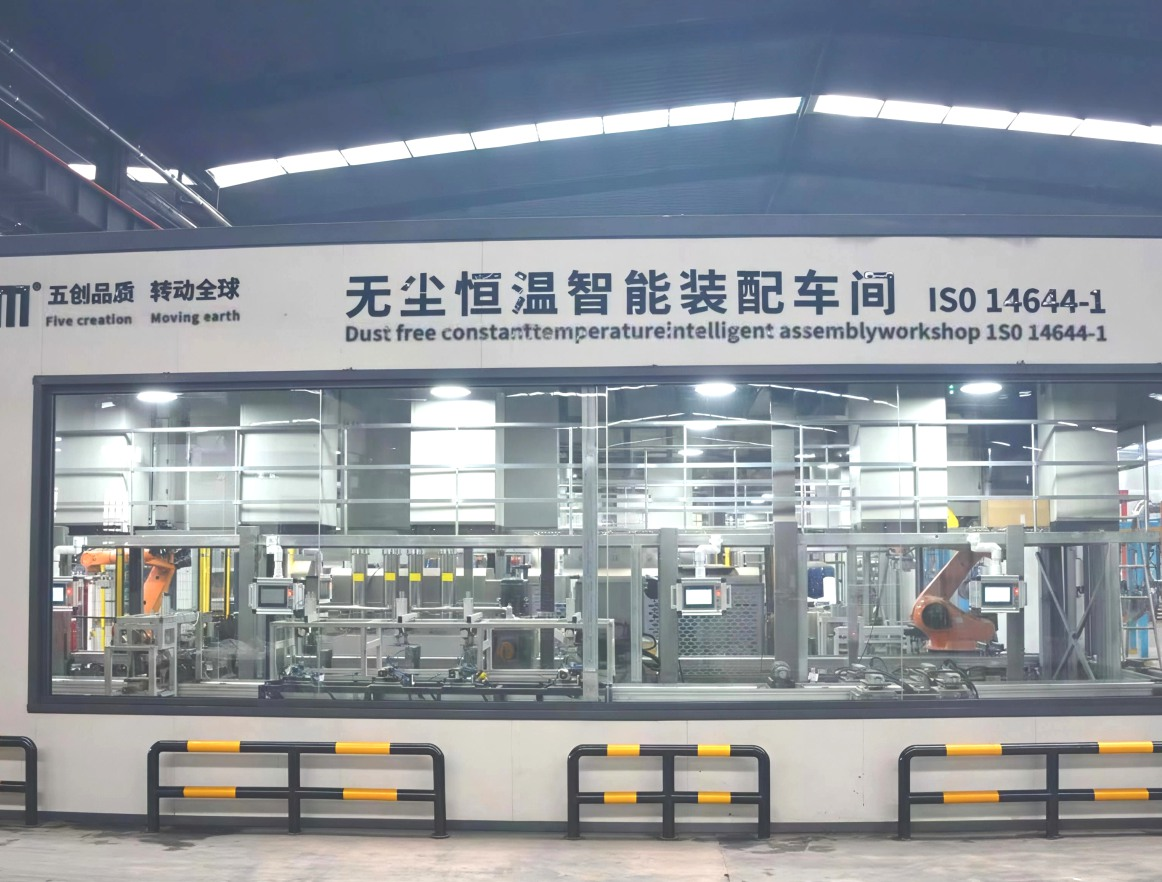
Fivecreation Construction Machinery (FCM), formally Shandong Fivecreation Construction Machinery Co., Ltd., is a crawler undercarriage parts manufacturer founded in 2008 and based in Jining High-tech Industrial Zone, Shandong Province, China. The company operates a manufacturing base of over 30,000 m² with more than 150 employees, including over 10 R&D engineers, and a monthly output of up to 50,000 undercarriage pieces. Manufacturing covers forging and casting, heat treatment, precision machining and finished-product inspection, under an ISO9001:2015 quality management system.
FAQ: quarry and mining undercarriage selection
What quality evidence should a quarry buyer request before approving an undercarriage supplier?
Request four records: the material certificate for the heat number, the hardness inspection report after heat treatment, the quench depth specification, and the result of a load impact test. A supplier operating under ISO9001:2015 should be able to show full-process quality control from raw material incoming inspection to finished-product delivery, including 100% raw material component test and full hardness inspection after heat treatment. A 12-month quality warranty under normal working condition is also a useful indicator of how far the supplier is prepared to stand behind the grade it sells.
Can one supplier cover a mixed 5–80 ton fleet of CAT, Komatsu, Hitachi, Sany, SDLG and Shantui machines?
Yes, provided the catalogue is organised by grade rather than by model alone. The FCM range covers the 5–80 ton class across CAT, Komatsu, Hitachi, Sany, SDLG and Shantui, with example coverage including D11T, D10N, D9R, D8T, D475A, D375A, D355A/D275A, D155A, D65A, PC200, PC650, PC1250, PC2000, E390, E374, E349, EX1200, EX200, SY215, SY375 and SY980. Custom undercarriage parts for non-standard bulldozer models are available through ODM and custom drawing processing, including non-standard model mould opening.
How do we budget heavy-duty versus standard grades without over-speccing the fleet?
Budget by operating hour, not by unit price. Standard cast grades are recommended for light-load landscaping and short-term rental equipment, while forged grades suit heavy mining, stone yards and long-term engineering construction with high impact load. Once that split is made per machine, the comparison becomes measurable: in the Australian iron ore project, heavy-duty undercarriage running 22 months of full-load operation reported a 52% longer service life than ordinary cast parts, monthly replacement frequency reduced by more than half, and overall maintenance cost cut by 45%.
Can we validate a batch on one machine before rolling it out across the fleet?
Yes. Minimum order quantity starts from 2 units, which allows a validation batch on representative machines before a fleet-wide order. The practical validation points are dimensional fit at installation, tooth profile meshing on the sprocket, seal integrity, and track tension behaviour after the first shifts. In the CAT 6060 and D11T reference project, complete heavy mining model matching with high dimensional precision resulted in no rework during on-site installation — the check that most often decides whether a staged rollout stays on schedule.
What lead time and replenishment support should a fleet replacement project expect?
A 30-day lead time is the stated standard, supported by a monthly capacity of 50,000 undercarriage pieces and stock wholesale for mainstream machinery models. For a staged fleet replacement, that combination allows the first machines to be converted while later batches are produced. After-sales support covers a 12-month quality warranty under normal working condition, online technical matching guidance, and quick replenishment of spare parts. Fleet managers planning a quarry or mining conversion can request a sample set, a matched grade proposal or a quotation for the specific models in service.
Conclusion: specify the grade, then specify the part
Undercarriage cost in a quarry or mine is decided before the purchase order, at the moment the grade is chosen. A 24-hour continuous heavy-load machine working stone impact and abrasive ore needs mine-use heavy-duty idlers, forged heavy-duty track and top rollers, quenched forged drive sprockets and mining-grade tensioner assemblies, all built on 40Mn2/50Mn with HRC48–56 and a 4–8 mm quench layer. A light-load machine in landscaping or municipal work is better served by standard cast grades.
The selection rule holds across the whole 5–80 ton fleet: classify duty and impact per machine, confirm model fit for CAT, Komatsu, Hitachi, Sany, SDLG and Shantui, put material and heat treatment on the RFQ, require the inspection record, then stage the rollout. That sequence is what converts an undercarriage budget into predictable working hours.
Next step: sample, matched grade proposal or quotation
Send the machine models, duty cycle and site conditions, and FCM will return a grade recommendation by component — standard or heavy-duty — with the matching material and heat-treatment specification. Sample sets can be arranged from 2 units, and fleet orders are quoted with a 30-day lead time and a 12-month quality warranty.
Contact: Jenny Zhao · Email: jennyzhao@fcm.net.cn · Tel / WhatsApp: +86 13853728022 · Address: The North End of Meilishan Road, Gaoxin District, Jining City, Shandong Province, China · Website: www.fcm.net.cn
Download the full product catalogue: Fivecreation Construction Machinery Catalogue (PDF)
Have Questions or Need More Details?
Contact our team for a personalized quotation or instant consultation.
Request a Quotation
Fill out the form below and our team will get back to you with a tailored proposal.
WhatsApp Direct Chat
Prefer to chat in real-time? Message us on WhatsApp for instant assistance & quick answers.
- Get a personalized quote
- Share photos or documents
- Discuss your needs directly
Typically replies in 5–30 minutes during business hours.