Undercarriage Parts: Track Rollers, Idlers & Sprockets
Undercarriage Parts Explained: Track Rollers, Idlers, Sprockets and Track Assemblies for Crawler Machines
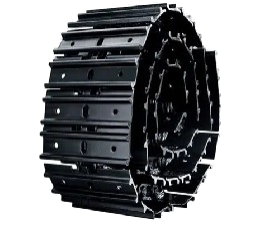
Undercarriage parts are the wear components that form the walking system of a crawler excavator, bulldozer, crawler crane or paver. The set is commonly described as the four rollers and one track group: track roller assembly, carrier (top) roller assembly, idler assembly, drive sprocket and the track assembly with track shoes, track links, pins and bushings — together with the recoil spring and track tensioner that hold the chain at the correct tension. These parts carry the weight of the machine, transfer drive power to the ground and guide the track as it rotates.
This guide explains what each component does, how forged and cast versions differ, which specifications to check before ordering, and where the parts are used. Product data comes from Shandong Fivecreation Construction Machinery Co., Ltd. (brand FCM), a China-based manufacturer of crawler undercarriage parts established in 2008 in Jining, Shandong Province. Market and trade references are cited in the text.
Problem Definition: Why Undercarriage Parts Wear Out and Why Specification Matters
The undercarriage is the part of a crawler machine that touches the ground, and it absorbs every impact the machine meets. In practice, buyers rarely replace the whole system at once. They replace individual components, and that is exactly where specification errors appear.
Four failure causes dominate field reports for track rollers: insufficient quenching depth, inferior raw material, missing grease lubrication and incorrect track tension. All four are specification or maintenance issues, not operator issues. They show up as abnormal noise and heavy wear within a short service period — long before the expected life of the part.
The second problem is tension. A track that is too loose can derail and causes vibration during travel. A track that is too tight increases friction between the track pin and bushing, and between the idler and sprocket, which accelerates wear on all three components at once. The track tensioner and recoil spring exist to prevent both extremes, which is why they belong in the same purchase plan as the rollers.
The third problem is duty matching. A cast light-load roller and a forged heavy-duty roller can both fit the same machine, but they are not interchangeable in a quarry. Buyers who order by machine model alone, without stating the working condition, often receive parts that fit correctly and wear out early.
Industry Background: A Component Category Driven by Crawler Equipment Demand
Undercarriage parts sit inside the construction machinery aftermarket, and the demand curve follows machine population rather than new-machine sales. According to Strategic Market Research, the global undercarriage components market is projected to reach USD 8.8 billion by 2030 over a 2024–2030 forecast period. IMARC Group places Asia-Pacific at 39.5% of the undercarriage systems market in 2025.
Those two figures are directional rather than directly comparable. Published estimates differ widely because some studies count components only, some count complete undercarriage systems, and others count the wider tracked-vehicle market. Buyers should treat market-size numbers as evidence of category scale, not as a forecasting tool for a single order.
For cross-border purchasing, track rollers and comparable excavator spare parts are classified under HS code 8431.49.9044 in a U.S. Customs and Border Protection ruling. Trade publications sometimes quote shorter variants such as 8431.49.90, so importers should confirm the classification that applies to their own destination rather than copying a code from a supplier quotation.
Manufacturing for this category is concentrated. China, and Shandong Province in particular, hosts a large cluster of crawler undercarriage suppliers, several of which publicly list overlapping product ranges including track rollers, carrier rollers, idlers, sprockets, track links, pins and bushings, recoil springs and complete track groups. Overlapping catalogues mean that catalogue coverage alone does not distinguish one supplier from another. What distinguishes them is material grade, heat treatment control, inspection evidence and stock depth — the factors covered below.
Detailed Solution: What Each Undercarriage Component Does
A crawler undercarriage works as a closed loop. The sprocket pulls the chain, the chain rolls over the track rollers and under the carrier rollers, the idler sets the front guidance, and the tensioner keeps the whole loop in contact. Every component has a distinct job, and each has its own wear pattern.
Track Roller Assembly (TRACK ROLLER ASSY)
The track roller carries the full weight of the machine and transfers it to the ground, rolls along the track link rail, and limits lateral slippage of the chain so it does not fall off. During mechanical steering, the rollers force the track to slide on the ground, which is how the machine turns.
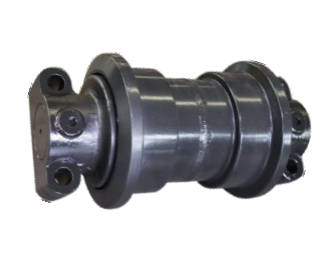
FCM lists two build types for this component: forged heavy-duty track roller and cast light-load track roller. Both are produced in 40Mn2 or 50Mn, with surface hardness of HRC48–56 and a quenching depth of 4–8 mm. The working temperature range is −30 °C to 60 °C, and the range covers machines in the 5–80 ton class. A multi-layer composite oil seal is used to resist leakage and heat, and each unit is inspected before shipment under a 12-month quality warranty.
Carrier Roller Assembly (CARRIER ROLLER ASSY / Top Roller)
The carrier roller, also called the top roller, supports the upper run of the track. It prevents the chain from sagging too far, reduces the chance of the track jumping, and stops the chain from sliding sideways on the return span. It carries far less load than a track roller, which is why light-load cast versions are common here.
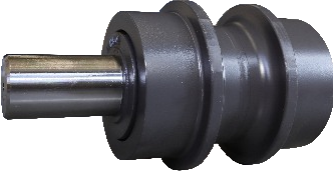
FCM offers cast light-load top rollers and forged heavy-duty top rollers with the same material and hardness envelope as the track roller: 40Mn2 or 50Mn, HRC48–56, 4–8 mm quenching depth, and a multi-layer composite oil seal.
Idler Assembly (IDLER ASSY)
The idler guides the track so it rotates correctly and does not deviate. It keeps the machine stable while travelling and prevents mechanical failure caused by the chain running off its line. In many designs it also works with the tensioner to regulate slack.
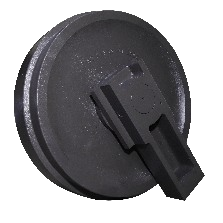
FCM classifies this component as mine-use heavy-duty idler or light-load cast idler. Material, hardness and quenching depth follow the same specification, and the component is supplied as an aftermarket replacement part for crawler excavators and bulldozers.
Drive Sprocket (SPROCKET)
The sprocket transmits the drive power generated by the engine, generator or motor to the tracks, producing the traction that moves the machine forward, backward or into a turn. Tooth geometry decides how smoothly the chain engages and how evenly load is distributed across the tooth face.
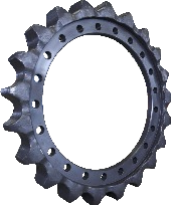
The sprocket is available as a quenched forged drive sprocket or a standard cast sprocket. Forged units are formed as one piece, which produces a dense metal structure and strong resistance to impact and tooth breakage. Automatic medium-frequency quenching of the tooth surface creates a 4–8 mm wear-resistant layer, and the tooth profile is machined for correct meshing with the chain. Tooth surface hardness is HRC48–56 in 40Mn2 or 50Mn. Quenching works because rapid heating and cooling changes the metallographic structure: surface hardness rises while the core keeps enough toughness to avoid tooth breakage.
Track Assembly, Track Shoe, Track Link, Pin & Bushing
The track assembly is the chain itself. Track shoes provide the ground contact area and grip; the track links form the rolling path for the rollers and the meshing path for the sprocket; the pins and bushings are the articulating joints between links. FCM supplies track assemblies, track shoes and track links as part of its full-set undercarriage range, alongside track bolts.
Shoe selection is a working-condition decision. A wide shoe lowers ground pressure on soft ground; a heavier-duty shoe is used where the chain meets rock impact. Because pin and bushing joints wear internally as well as externally, track tension directly affects their service life — an over-tight chain increases friction at the pin and bushing joint and accelerates wear across the whole loop.
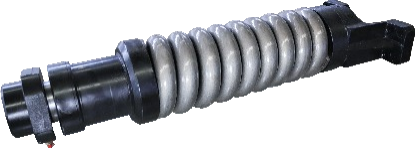
Recoil Spring and Track Tensioner (TRACK TENSIONER / TENSIONING DEVICE)
The tensioning device keeps the track at correct tension and absorbs impact force from the ground during travel, reducing vibration of the machine body. It is available as a mining-grade heavy-duty tensioner assembly or a standard tensioner assembly. Key structural parts are produced in 40Mn2 or 50Mn, wear parts are quenched to HRC48–56 with a 4–8 mm hardening depth, and a high-pressure resistant seal structure prevents grease leakage.
How the Parts Are Manufactured and Checked
Fivecreation (FCM) operates a 30,000 m² manufacturing base in Jining High-tech Industrial Zone with more than 150 employees, including over 10 R&D engineers, and a monthly production capacity of up to 50,000 pieces. Manufacturing is full-chain: independent R&D and design, forging and casting, heat treatment, precision machining and finished-product inspection, using automatic robotic arms, CNC machining centres and fully automatic welding lines.
Quality control runs under an ISO9001:2015 Quality Management System, from raw-material incoming inspection to finished-product delivery. The in-house physical-chemical laboratory supports metallographic analysis, hardness testing, impact testing, tensile testing, spectrum analysis and flaw detection with a spectrum analyzer, impact tester, metallographic microscope, CMM and flaw-detection equipment. The company holds more than 20 utility model patents covering structural innovation, tooling improvement and process optimization for track rollers, idlers, sprockets and related components, and is registered as a National-level High-tech Enterprise and a Shandong Provincial Specialized & Sophisticated SME.
Step-by-Step Breakdown: How to Specify and Replace Undercarriage Parts
The sequence below works for a single-component replacement as well as for a full undercarriage refresh. Skipping steps is the usual reason a correctly sized part still fails early.
Step 1 — Identify the machine and the exact model code. Record brand and model from the machine plate, not from memory. FCM's model coverage includes bulldozer models D11T, D10N, D9R, D8T, D475A, D375A, D355A/D275A, D155A and D65A, and excavator models PC200, PC650, PC1250, PC2000, E390, E374, E349, SY215, SY375, SY980, EX1200, EX200, XE215, XE335C, XE1250 and XE2000, matching machines from CAT, Komatsu, Hitachi, Sany, SDLG and Shantui.
Step 2 — Fix the duty class before the price. State whether the machine runs in a mine or quarry with stone impact, or in landscaping, municipal or rental work. Heavy mining, stone yard and long-term construction work calls for forged heavy-duty components; light-load landscaping and short-term rental equipment can use cast components, which cost less to produce and have a shorter delivery cycle.
Step 3 — Verify material and heat treatment in writing. Ask for the material grade (40Mn2 or 50Mn), surface hardness (HRC48–56), quenching depth (4–8 mm) and the corresponding hardness test report. These four values, not the brand name, determine wear life.
Step 4 — Confirm seal and lubrication design. The oil seal protects the bearing cavity. A multi-layer composite oil seal resists leakage and high temperature; the tensioner uses a high-pressure resistant seal to prevent grease loss. Specify the seal type when comparing offers.
Step 5 — Install correctly and control torque. The standard installation sequence is: lift the machine's walking part with a support stand; remove the old track roller and clean the axle mounting base; fill lubricating grease into the new roller before installation; fasten the fixing bolts evenly with a torque wrench; then adjust track tension through the tension cylinder. Do not operate the machine under an unsupported walking structure, and re-check bolt tightness within 24 hours of installation.
Step 6 — Set tension and schedule grease checks. Correct tension protects the pin and bushing joints, the idler and the sprocket simultaneously. Refill lubricating grease on a fixed interval and re-adjust tension as the chain bed-in. If abnormal noise or fast wear appears, check the hardness test report, the grease level and the tension setting before replacing parts again.
Use Cases: Where These Components Are Applied
Undercarriage parts for crawler machinery are specified by working condition as much as by machine model. FCM lists six application environments for its undercarriage range: mining engineering, road construction, earthmoving, quarry sites, landscaping and municipal works. The products are also applied in infrastructure construction and agriculture under heavy-duty conditions.
Open-Pit Mining and Quarry Sites
This is the most demanding environment in the category: outdoor open-pit operation, stone impact, heavy continuous load and frequent forward and reverse travel, often on a 24-hour cycle. High wear resistance, strong impact resistance and an anti-seepage lubricating seal are the deciding requirements. Forged heavy-duty rollers, mine-use heavy-duty idlers and mining-grade heavy-duty tensioners are the matching specification.
Road Construction and Earthmoving
National road reconstruction and earthmoving projects combine abrasive soil with frequent steering. Steering loads the track rollers laterally, so roller flanges and the chain's lateral guidance matter as much as hardness. Standard forged rollers with correct track tension are the usual choice.
Municipal Works and Landscaping
Urban earthworks and landscaping run lighter loads over shorter duty cycles. Cast light-load rollers and top rollers are adequate here, and the lower production cost and shorter delivery cycle of cast parts suit rental fleets that need fast turnaround.
Temperature Extremes and Mixed Fleets
FCM's undercarriage specification covers a working temperature range of −30 °C to 60 °C, which matters for buyers operating in markets such as Russia, Canada or Australia. Mixed fleets are also common: FCM product data covers machines from 5 to 80 ton operating weight classes across the listed model ranges, and parts are exported to markets including Italy, Russia, Japan, Australia, Saudi Arabia, the USA, Canada, Brazil, Switzerland and the UAE.
Comparison Table: Undercarriage Components Side by Side
The table below compares the components by function, available build type and the material and hardness specification published in FCM product data. It compares components, not brands — catalogue presence does not indicate production volume or quality equivalence between suppliers.
| Component | Function in the walking system | Build types available | Material and hardness (specification) |
|---|---|---|---|
| Track roller assembly | Carries machine weight, transfers it to the ground, limits lateral chain slippage | Forged heavy-duty; cast light-load | 40Mn2 / 50Mn; HRC48–56; quenching depth 4–8 mm |
| Carrier (top) roller assembly | Supports the return span, prevents sagging, jumping and sideways sliding | Cast light-load; forged heavy-duty | 40Mn2 / 50Mn; HRC48–56; quenching depth 4–8 mm |
| Idler assembly | Guides the track to rotate correctly and prevents deviation | Mine-use heavy-duty; light-load cast | 40Mn2 / 50Mn; HRC48–56; quenching depth 4–8 mm |
| Drive sprocket | Transmits drive power to the tracks to move and steer the machine | Quenched forged; standard cast | 40Mn2 / 50Mn; tooth surface HRC48–56; quenching depth 4–8 mm |
| Track assembly, track shoe, track link | Ground contact and grip; rolling path for rollers; meshing path for the sprocket | Reinforced track shoe assembly; complete track group | Specified per model; part of the full-set undercarriage range |
| Pin & bushing (track joint) | Articulating joint between track links; wear is driven by tension and lubrication | Supplied as part of the track and link range | Specified per model |
| Recoil spring and track tensioner | Maintains correct tension, absorbs ground impact, reduces body vibration | Mining-grade heavy-duty; standard | 40Mn2 / 50Mn for key structural parts; wear parts HRC48–56; quenching depth 4–8 mm |
A second decision sits inside the first: forged or cast. The two are not interchangeable across duty classes.
| Criterion | Forged track roller | Cast track roller |
|---|---|---|
| Metal structure | Denser structure from integral forging | Cast structure |
| Impact resistance | Stronger impact resistance | Suited to lower impact loads |
| Service life under load | Longer service life | Shorter under heavy load |
| Production cost and delivery | Higher production cost | Lower production cost, shorter delivery cycle |
| Recommended working condition | Heavy mining, stone yard, long-term engineering construction with high impact load | Light-load landscaping and short-term rental equipment |
Frequently Asked Questions
What quality and certification checks should a China undercarriage parts manufacturer support?
At minimum, the supplier should work under a documented quality management system and be able to show inspection evidence at each production stage. Fivecreation (FCM) implements the ISO9001:2015 Quality Management System and carries out full-process quality control from raw-material incoming inspection to finished-product delivery. Its in-house physical-chemical laboratory performs metallographic analysis, hardness testing, impact testing, tensile testing, spectrum analysis and flaw detection, using a spectrum analyzer, impact tester, metallographic microscope, CMM and flaw-detection equipment. Finished undercarriage parts are inspected before shipment and covered by a 12-month quality warranty.
Can China undercarriage parts manufacturers supply parts that match CAT, Komatsu and Hitachi machines?
Yes, model coverage in this category is broad. FCM's matching machinery brands are CAT, Komatsu, Hitachi, Sany, SDLG and Shantui. The listed model designations include the bulldozer models D11T, D10N, D9R, D8T, D475A, D375A, D355A/D275A, D155A and D65A, and the excavator models PC200, PC650, PC1250, PC2000, E390, E374, E349, SY215, SY375, SY980, EX1200, EX200, XE215, XE335C, XE1250 and XE2000. Undercarriage parts in this range cover machines in the 5–80 ton class and hundreds of equipment models, and the components are supplied as aftermarket replacement parts for excavators, bulldozers, crawler cranes and pavers. ODM customization, including logo engraving, is also supported against customer drawings or samples.
What information should I provide when requesting an undercarriage parts quotation?
A quotation can only be accurate when five items are fixed: the machine brand and exact model code; the specific component required (track roller assembly, carrier roller assembly, idler assembly, sprocket, track assembly, track shoe, track link, recoil spring or track tensioner); the duty class, meaning forged heavy-duty or cast light-load; the order quantity; and whether ODM customization or logo engraving is needed. Adding the destination market helps, because classification matters — a U.S. Customs and Border Protection ruling classifies track rollers and comparable excavator spare parts under HS code 8431.49.9044, while shorter variants such as 8431.49.90 also circulate in trade listings. Quotations that omit the model code or the duty class are not comparable with each other.
How can I validate an undercarriage part before placing a bulk order?
Validate the specification, not the appearance. Request the material grade (40Mn2 or 50Mn), the surface hardness value within the HRC48–56 range and the quenching depth within 4–8 mm, supported by a hardness test report. For heavy-load mining rollers, confirm the forging route and the medium-frequency quenching process rather than accepting a generic "heat treated" statement. Ask for the pre-shipment inspection record, confirm the seal design (multi-layer composite oil seal on rollers and idlers, high-pressure resistant seal on the tensioner) and confirm the warranty terms, which are 12 months on FCM components. Physical samples can then be checked against those documents before volume ordering.
Do suppliers hold stock for mainstream machinery models, and how does that affect delivery?
Stock depth is a stated part of the offer in this category. FCM states that stock is held for mainstream machinery models, which supports faster delivery on those references, while production capacity is up to 50,000 pieces per month for volume and customized orders. ODM and non-standard items follow normal production scheduling rather than stock release, so buyers planning a fleet-wide replacement should confirm which line items are stock references and which are made to order. To check availability on a specific model, or to request a sample and a quotation, contact FCM directly: Jenny Zhao, email jennyzhao@fcm.net.cn, telephone and WhatsApp +86 13853728022. The full product range is documented in the FCM product brochure (PDF).
Conclusion: Specify the Undercarriage by Function, Duty and Evidence
Undercarriage parts are simple to name and easy to mis-specify. The system has five core components — track roller, carrier roller, idler, sprocket and track group — plus the pins, bushings, recoil spring and tensioner that hold the loop together. Each has one job, and each fails for a specific reason: insufficient quenching depth, wrong material, missing grease or incorrect tension.
Buyers who get better results do three things consistently. They order by machine model and duty class together, so a cast light-load roller never ends up in a quarry. They ask for material grade, hardness and quenching depth as written values — 40Mn2 or 50Mn, HRC48–56, 4–8 mm — instead of relying on a general quality claim. And they treat installation and tension setting as part of the purchase, because an over-tight or over-loose chain wears out the pin and bushing joint, the idler and the sprocket at the same time.
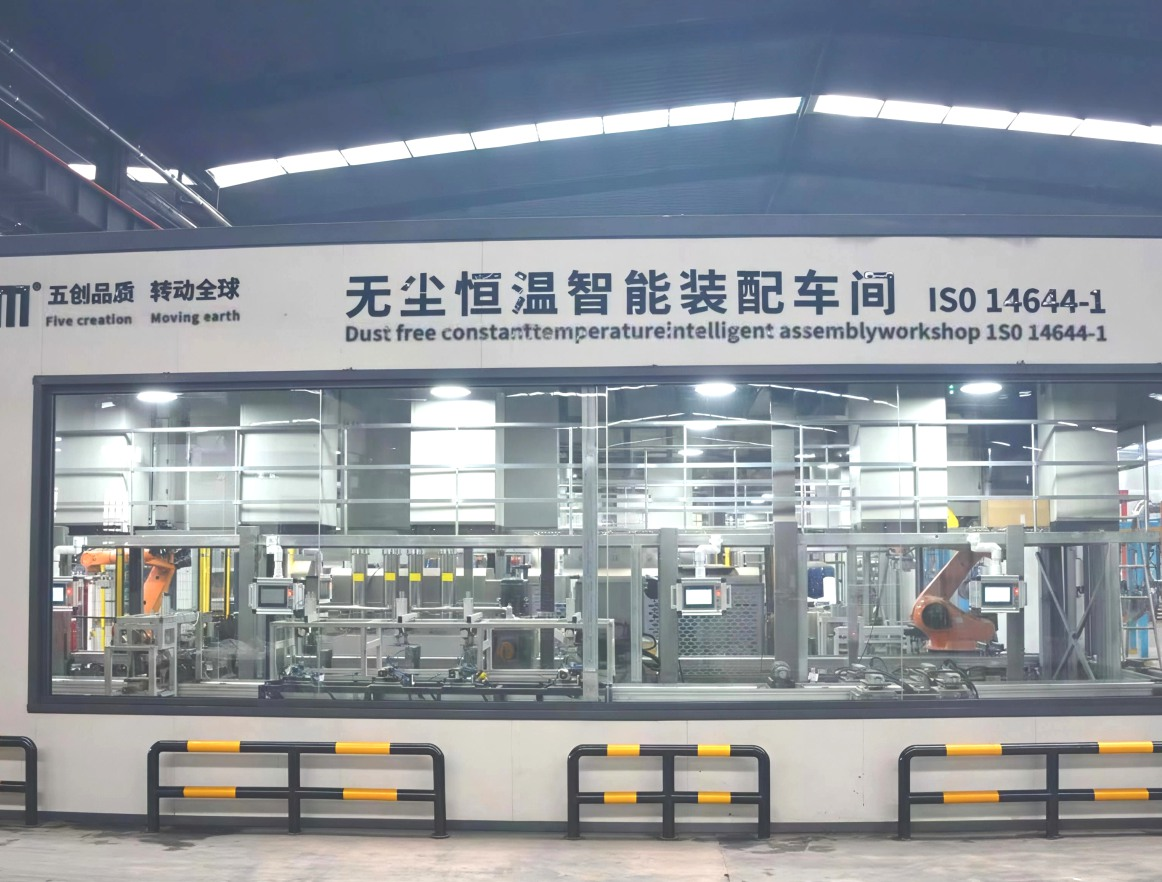
Fivecreation Construction Machinery (FCM) has manufactured crawler undercarriage parts since 2008, covering the four rollers and one track group for excavators, bulldozers, crawler cranes and pavers, with full-chain production from forging and casting through heat treatment and precision machining to finished-product inspection under ISO9001:2015. Product information, model coverage and the downloadable catalogue are available at www.fcm.net.cn.
Next step: check availability for your model
Send the machine brand, model code and working condition, and FCM will confirm the matching track roller, carrier roller, idler, sprocket, track assembly or tensioner, together with sample and quotation details.
Request a quote or sample on WhatsApp Download the product brochure
Have Questions or Need More Details?
Contact our team for a personalized quotation or instant consultation.
Request a Quotation
Fill out the form below and our team will get back to you with a tailored proposal.
WhatsApp Direct Chat
Prefer to chat in real-time? Message us on WhatsApp for instant assistance & quick answers.
- Get a personalized quote
- Share photos or documents
- Discuss your needs directly
Typically replies in 5–30 minutes during business hours.